My comfort zone is distributed systems, where hard problems usually look technical. Rip My Build flipped that around: the code was the easy part; finding people who cared was the experiment.
Start with the question
By December 2025, AI had changed how quickly I could turn an idea into working software. That left a more interesting question: if building was no longer the slow part, what did I need to learn next?
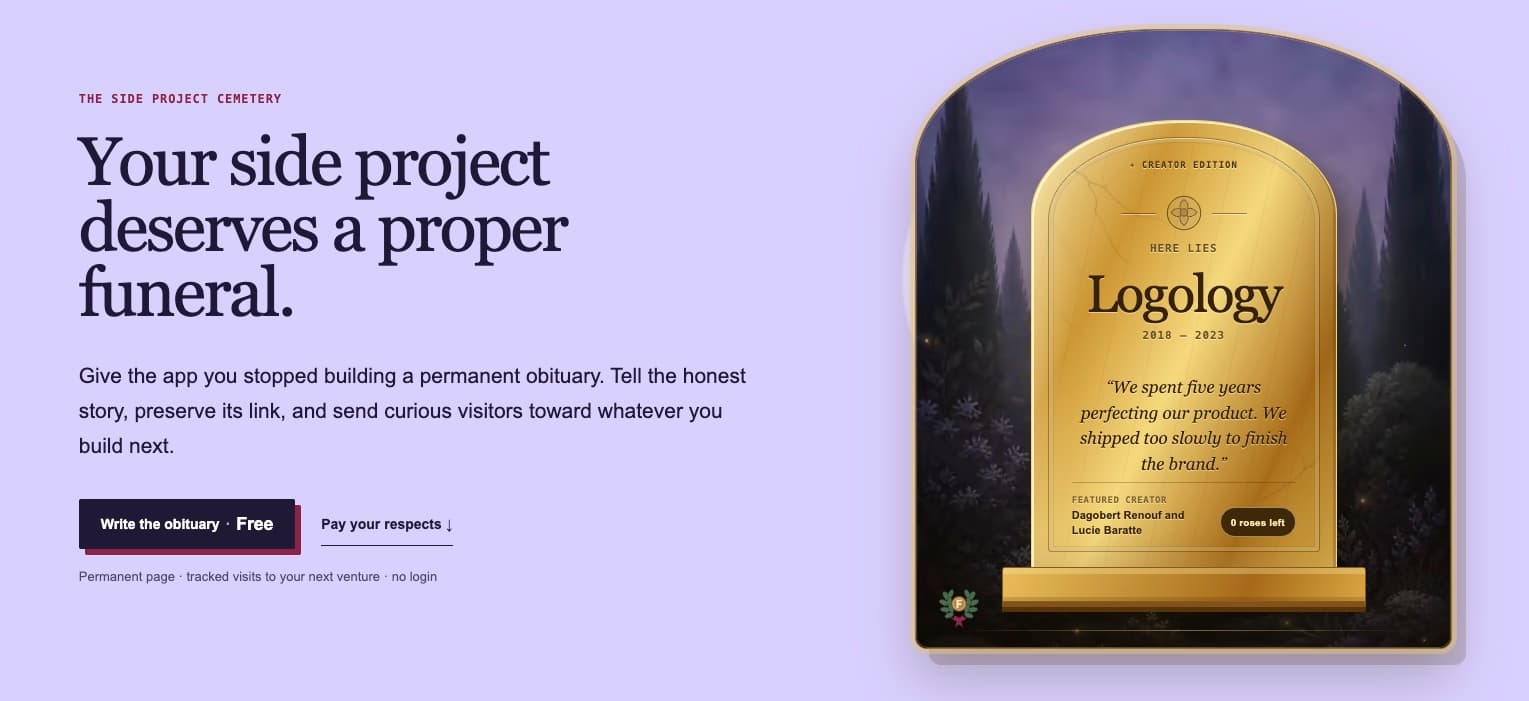
For a first test, I chose something deliberately small and a little playful. Rip My Build gives abandoned side projects an obituary instead of pretending every launch becomes a company. The product was real, but compact enough that distribution could remain the main unknown.
Building it gave me almost no resistance. I pushed PageSpeed Insights toward 100 in every category, connected Google Search Console and Bing, added payments, and deployed on Vercel. Then I ran out of familiar territory.
“A launch is not only a verdict on the product. It is also a measurement of how well the product found its people.”
Now look at the launch
I did what a beginner does: prepared a Product Hunt launch and submitted the project to every site offering a free listing. Somewhere along the way, Orynth apparently launched a Solana token for it. The dashboard showed $86.54 in creator market earnings. I still do not know who bought it.
Then Jonathan Wilke saw the project and generously posted about it. His post reached 22.1K views. That attention brought 1,761 visitors and six obituaries. Two came from friends. Total revenue remained exactly $0.
What can the numbers actually tell us?
It is tempting to compress the whole launch into one number: $0. But that throws away most of the information. Revenue answered one narrow question. It did not tell me whether the idea made someone smile, whether the story resonated, or whether I was learning how to reach the right people.
The six submissions were evidence that a few people understood the idea well enough to participate. The traffic spike showed how much distribution depends on trust that already exists somewhere else. And the quiet periods showed the obvious but important lesson: without an audience, even a good idea may pass unseen.
A rule for the next experiment
A useful experiment isolates one uncertain thing. Here, building was not the uncertainty; distribution was. Next time, I can keep the product small and try a better way of finding its people.
AI experiments can get expensive, so if your budget is small, shrink the question, not your curiosity. One question. One feature. One launch. One lesson.
Money and reach change the speed of the journey. They do not decide who gets to take it. If you do not have an audience, backing, or a large budget, begin with something small enough to finish and interesting enough to teach you what to try next.